|
11.06.2003
'Civilisation
in its entirety, the possibility of human, life depends upon a reasoned
estimation of the means to assure life. But this life-this civilised
life-which we are responsible for assuring, cannot be reduced to these
means, which make it possible. Beyond calculated means, we look for
the 'end-or the ends', -of these means.'
Story of life, and the story of death.
Can a story be written, depicted without a beginning and an end?
This story starts with death towards life; -if I may say this.
'How can we start talking about death? '
Common anxiety, which leads itself to a kind of intimacy, occurs in
the books which death is scrutinised-either spiritually, psychologically,
academically or culturally.
Everybody has an idea about what nobody knows.
If we were to find ourselves in a kind of introspection, we would not
even remember how it all has started, and how one has come across with
the idea of dying, and death. However introspection entails remembering,
questioning, even be brave, get intimate and intimidated.
What one could not grasp, can it be assumed as what one has always been
curious about?
Freud says curiosity is opportunism .
I find myself asking the question, all this opportunistic tendency,
where will it lead me, lead the reader in terms of the idea of death
and dying? Am I there to change anything about the unknown?
Being curious about death, I have to admit it is the very curiosity,
affinity of and wander through the life itself; to what extent one can
deal, perceive and consume the idea.
The lack of knowledge or explanation leads us to explorations in cognition
and communication. If there is a lack of something there is not enough
information; then does it not exist at all? Donald Norman emphasizes
that we are ‘explanatory creatures’ . On one hand human
being has always found easy to tackle things which are simple and understandable.
On the other hand curiosity of unknown desires and knowledge keeps us
alive.
'There are just collection of words that seem to do justice to the complexity
of what we feel.'
Nevertheless, when it comes to Death, it is personal, the idea of death
in our minds is quiet, waiting to be explored, but this exploration
will only be when it comes. It sounds so dramatic, but doubtless to
say that 'death is a solitary' as Elisabeth Bronfen puts forward in
the preface of the book 'The limits of death.' It is one of those things,
which isn't experienced but accepted as a fact of life. Sooner or later
it is there to be experienced by every single person. That is why it
is almost beautifully intimate and individual.
Yet, there is some chaos, confusion and clutter about death when one
is asked-quite expectedly.
Maybe the whole group would agree or be pleased to discuss about what
is after life, what happens to soul-if there is, what would we be feeling
when we are already dead.
Especially when a loved one is passed away, it gets difficult to come
to terms with the tragedy of loss, grief, anger and shock. In order
to get rid of the emotional scars being starts to look for evidence
that 'they are ok, they are doing alright'. Rather than the knowledge
and awareness of reality, loved ones appear to be 'around, talking,
sending messages' from where they are.
Does it change anything to find out the answers of all these questions
about after life? Does it comfort and justify our 'desired-immortal'
existence in a way so that human being can take a deep breath and relax?
Maybe, up to a certain degree, one would feel like untangling all the
trouble, the entire puzzle, and feel safe within. Having a celestial
cup of tea with the loved but dead ones. Why not? The puzzle is solved?
This project is about not solving the puzzle but more about identifying
the puzzle.
Death has always been the catastrophically pleasurable puzzle.
Psychoanalysists say that (Adam Philips) obstacles are represented by
our desires, created by the object of unconscious desire . Everything
might appear to be an obstacle, but death is the absolute obstacle over
all things in one's life. If you are dead, you won't be able to do what
you desire to do with your life. If we were to arrange our desires,
would we erase death from life? Reverse the idea of death.
What an idea!
Let us imagine death-less lives, let us imagine being immortal, getting
frozen, waking up and then sleeping again but without an end. Would
it not be so boring, so unbearable? There would be no story without
an end.
The idea even cannot be extended. Forever consciousness. Even though
the idea of forever consciousness sounds quite unattainable, it still
does bring fear, horror to my thoughts. But still it is a matter of
choice, if one is to believe and feel safe within the idea, let them
be.
However, strangely enough, it would not be wrong to assume that one
is ready to accept this kind of immortality in life in order to eliminate
the idea of death, an ending. One has got a tendency to avoid suffering,
death and dying, since as Wittgenstein points out quite realistically;
'Death is not an event of life. Death is not lived through.'
It is true; death is only the event of life for the other, and other
only. It is not lived through, not experienced by the very first hand
and then put into words. One can solely be death's underdog. It is not
possible to talk about death 'itself'.
'In order to be a normal functioning human being, you must deny death'
with big blue letters, here it is, on the magazine, smiling at you.
Maybe Wittgenstein was one of those 'normal functioning human beings'?
(A bad joke about being 'normal' and about Wittgenstein, although it
brings so many disputable arguments about what does actually being normal
mean?)
Then again history is full of second hand experiences, stories, poems
about death; the narrative is there to create a meaning; figures, deceased,
fallen soldiers, victims are there to be viewed by the third party.
The meaning has already constructed and will be. The very presence of
the absence is represented by the presence.
The philosophy of death creates hesitation, anxiety and intimacy again.
I will refrain from challenging the ideas at this very moment. But will
go back to questioning the meaning of death later.
For this very moment, lets be pragmatical and observe.
I have got a packet of Marlboro beside me, saying on top of it, with
huge letters 'smoking kills, smoking can cause a slow and painful death.'
I light another one knowing that, yes it is part of the game, it can
happen, pretty slow, and painfully. (I could not even dare to say the
word once more, the word 'death'. I just realised that.)
What does it make me feel like to read that assumption, powerful assumption,
thou one would not address it as an assumption, since it is a known
fact? Does it stop me from smoking? Does it stop me from thinking, yes-painful
death would be a nightmare but I must ignore, at least for the very
moment and for the sake of my 'pleasure'.
-Lights another one.
I recall Bjork's lyrics where she sings painfully 'I play dead because
it stops hurting.'
This romantic idea about death has begun at the beginning of eighteenth
century. Human being has learnt how to find gratification, entertainment
and eroticism in death. Indulgence through the affinity of the unknown.
Marlboro definitely not is one of those romantics. On the contrary,
now it is the time of consumption and awareness, not even allowed to
indulge too much other than consuming the product and eating it selfishly.
The wish for a desire is sold, created and lost its meaning. What are
the preconditions of desire in that sense? A product probably, would
solve, with a clever slogan, marketing strategies and so on. Vertiginous
baffles of the possibilities. I have heard a great made up word from
an infamous poet where he plays with the word possibilities as possibili'tease'.
I could not help but think about the current condition of consumption
and material world is all about possibili'tease'.
But, what is the relation to the idea of death, why I end up talking
about consumption here?
Probably it is all because of that Marlboro.
I do smile, yes. I'm being clever here. I blame Marlboro because it
made me to think once again about death-as if I was not thinking.
As a matter of fact death is everywhere. There is no need to pretend
or ignore.
On TV screen just recall the recurring images of 'Think' ad about car
accidents, in hyper-reality choose from the 'destruction and dead' menu
or even learn when you will die, in art come across with Helnwein images
and once more feel the repressed knowledge of death and suffering. Or
just imagine it might be even at the door.
Wherever one looks, one can easily identify the idea of suffering, dying
and death.
'Are we phobic of all the things we never do and all the places we never
go, unconsciously phobic, as it were? ' Beautiful question from Adam
Philips reminding us that this can easily be applied to the idea of
death. Towards death we might be totally, unconsciously phobic. He also
points out that phobias are limiting opportunities. The opportunity
of death? Death can be an opportunity of what? Of life?
For sure death itself cannot be an opportunity of life-since they are
sort of relatives, quite close friends, even best mates. But the idea,
the perception and the very scrutiny of this puzzle as a means of identifying
and displaying the purpose of death in our lives, would no doubt bring
a new insight and a new narration to the puzzle and the unknown.
Death demands a certain understanding and reliable insinuation.
The issue of mis-representation of death is so open to indulgence, disgust,
and inhuman contingencies as well as challenging concepts, theories
and inspiration.
Can we talk about the representation of death without establishing the
conception of death?
Or are they inseparable? Since there can be no reality of death in terms
of its representation, there can also not be a narrative about death
itself. It is like a circle; being is circling around what is unfamiliar
in order to invent a confident familiarity within.
As a matter of f-act, we do not have any choice but to assimilate the
attitude towards death through narratives, figures and images in order
to dig this rabbit hole. Indeed it is a deep one.
Death is presented as part of the language, image and representation,
whereas death itself stays at ease quietly as if it is a character watching
and observing how the human being can overcome the fear and consternation.
Death can only be depicted as a conception, out of spectator's realm
of experience.
'The war we never saw, the true face of war'; that is the name of the
programme which was shown on 5.June 2003, on Channel 4. Yes, we saw
the true face of war and we witnessed the victims' suffering, unfairness,
pain and agony within stupefaction. Disturbing images of bodies, hands,
brains, parts of human beings, all those 'relics' were everywhere and
nowhere at the same time.
How one is supposed to read these images?
How one is ready to accept the dilemma between 'an assurance of a recuperated
mastery over and submission before the irrevocable law of death?'
The spectator hesitates, feels anxious, like the adrenaline slowly starts
pumping through brain, and suspense claws ravenously.
Repressed knowledge of death, becomes accessible through the representation
of death, distorts the order; the order of everyday life, the order
of mundane.
The acknowledgement of death 'in someone else's body' occurs as an image
or as a narrative. Ambivalence between death and life creates disturbance,
and repressed knowledge of death places itself somewhere far away from
the self.
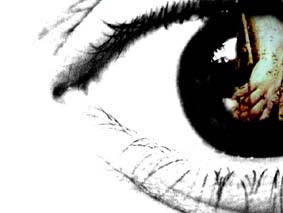
On beholder's eye (I) there will be doubt and delaying up until one
recognises the realm of mortality. But not always this realm is experienced,
the image is most of the time read in a manner, which the spectator
is far beyond empathising. Because s/he is in no position to identify
any familiarity, whatsoever. Either chooses to ignore in order to protect
or once more as psychoanalysists points out; repress the knowledge of
mortality.
Then how do we associate ourselves with the reality of death and dying
within the representation of death?
The representation of death 'point obliquely to that which threatens
to disturb the order but articulate this disturbing knowledge of mortality
in a displaced, re-coded and translated manner, and by virtue of the
substitution render the dangerous knowledge as something beautiful,
fascinating and ultimately reassuring.'
The programme created a kind of confrontation of my repressed knowledge
of war and death. It was more like an exorcism, like I was being drawn
to a picture where death was behaving badly. But I have to admit that
I felt that I was ready to challenge my repressed knowledge even though
the images created a terrible disturbance. Eventually, I came to a conclusion
maybe that experience, which was out of my realm of experience, was
sensitising rather than desensitising. Because the display of death
was too realistic maybe more than spectator can bear, but still it was
necessary up to a certain degree in order to come to terms with the
tragedy which was and is being experienced there. Elimination throughout
reasoning not something 'beautiful, fascinating' but 'reassuring'.
I have started to this project with adopting the notion of the idea
that we have become more desensitised with the help of films, media
and art. The images of death have changed our consciousness, awareness
through the reality of death, in a way that they have created a kind
of de-fence mechanism. This de-fence mechanism causes the spectator
to create his or her own fantasy within a specific reasoning so that
it is safe to view the display of death without getting so sympathetic
and empathic.
Certain modes of understanding have been established while reading these
images.
'The possibility of all imagery of all our pictorial modes of expression
is contained in the logic of depiction.'
There can be ways of investigating the models of understanding, via
psychoanalysis, philosophy or culturally and sociologically, yet I suspect
when the emphasis is on the study of the individual, there will be always
the same conclusion.
At the end of the day individual constructs his or her value judgements
through the reality of things, or the thing called 'reality' in terms
of its logical depiction.
I can easily indulge myself to examine the tacit knowledge behind this
reading within philosophical approach.
Value judgements of reality become quite intimate and intrinsic like
death itself. Having said that I would like to imply that for me it
was necessary to come to an understanding of the events-while watching
that programme-but that does not mean the other spectator is ready there
to manipulate same kind of reaction.
So how can we generalise or categorise the modes of understanding?
Is it possible to speculate the modes of understanding within a generalised
concept?
However, to scrutinise culturally and socially how it is constructed
and examine the normative, and society's behaviour to the images of
death, hopefully will bring some concrete explanation to the models
of understanding.
|
 BACK
BACK