|
to return |
TEXTS ABOUT ARTISTS' USE OF MEMORY
|
to return |
TEXTS ABOUT ARTISTS' USE OF MEMORY
Bibliography
Gombrich,E. - Art and Illusion, Phaidon, London, 1990
Graham-Dixon, A. – Howard Hodgkin, Thames and Hudson, London, 1994
Grosz, G. – An Autobiography, University of California Press, 1998
Hyman, T. & Wright, P.(eds.) – Stanley Spencer , Catalogue to the
Tate Gallery exhibition 2001, Tate Gallery Publishing, London, 2001
Matossian, N. - Black Angel: a life of Arshile Gorky, Chatto and Windus, London,
1998
Rugoff, R. – Scene of the Crime, MIT Press, Mass. US, 1997
Ryan, E. – Robert Indiana: figures of speech, Yale University Press, New
Haven, US, 2000
Arts Practice References
Hodgkin, H:
Graham-Dixon, A. referring to Hodgkin: “The painted world within a world
and the eye’s journey through to it become analogues for the painter’s
own, temporal struggle; the viewer’s struggle to get from one place to
another, to make the leap from the world in front of the painting to the world
”Grantchester Road” 1975
Illingworth, S:
Memory and Forgetting brings together four artists and four scientists to collaborate on new ways of thinking about and interpreting ideas of memory. The participating artists are Daniel Sturgis, Louise K Wilson, Shona Illingworth and Ashley McCormick.
The Hatton Gallery, University of Newcastle. 22nd March - 24th May 2003
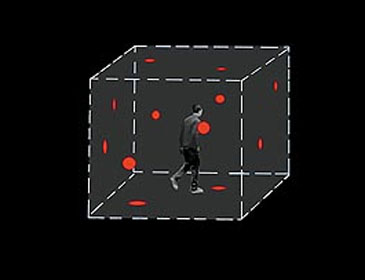
above: working drawing. Shona Illingworth and Martin Conway
Professor Martin Conway (Department of Psychology, University of Durham) works on autobiographical memory, the transitory mental constructions generated by the "working self" from an underlying knowledge base, using findings from neuro-psychology and recent brain imaging studies.
Shona Illingworth is an artist whose film and video work is intrinsically linked to language and visualization: she is interested in the fragility of human presence and the shifting relationship between interiority and the world.
From the research project Shona has already identified that her new work will explore issues relating to the construction of identities, to sustaining a sense of self over time, and to the understanding, conceptualization and registering of spatial relationships in thought and memory processes will be explored. The work will be informed both by a scientific study of neurology and clinical research, and by a more expressive and conceptually based exploration of the shifts in focus between the internal spaces of thought and memory and the external physical word.
Indiana, R.
From an artist’s statement: “Signs loomed large throughout my whole life. First there was the huge round Phillips 66 sign that rose high above the flat skyline of my hometown. I saw it and felt every year of my youth there for it happened to stand, perched on two girders, on the very route that my father took to work each day for many years. It also just happened that he worked for the very company that it announced red and green against the sky. His sign; my sign. And it was about the highest thing (in my imagination) in town save the spectacularly ugly war monument that dominates the centre of Indianapolis.” (Ryan, E., p.259)
Ryan, E : “Indiana is a supreme example of this retrospective consciousness that pairs collecting and recollecting” (Ryan, E., p.11)
 to
return
to
return